FAQ
What comes in a box?
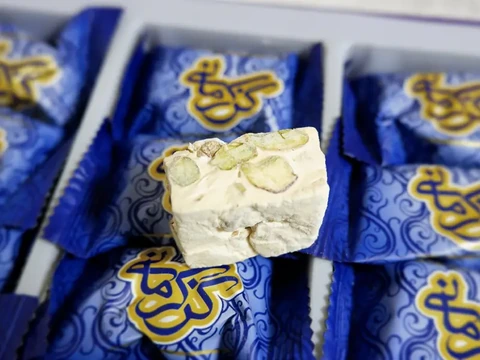
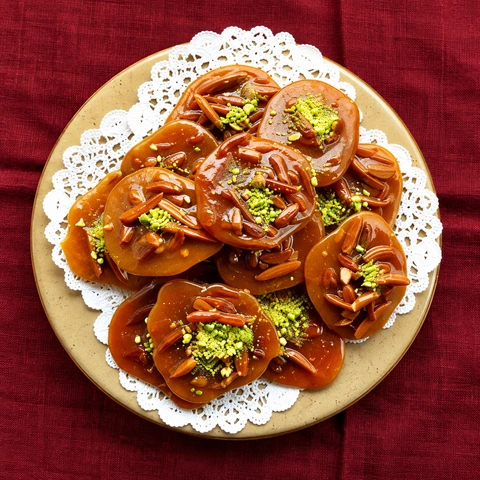
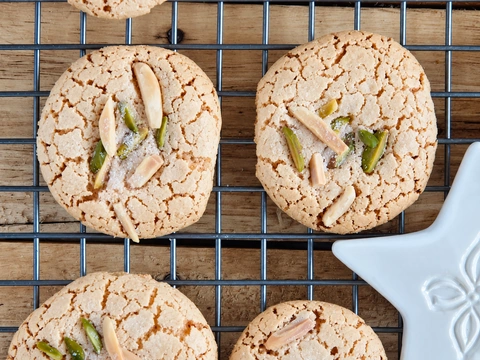
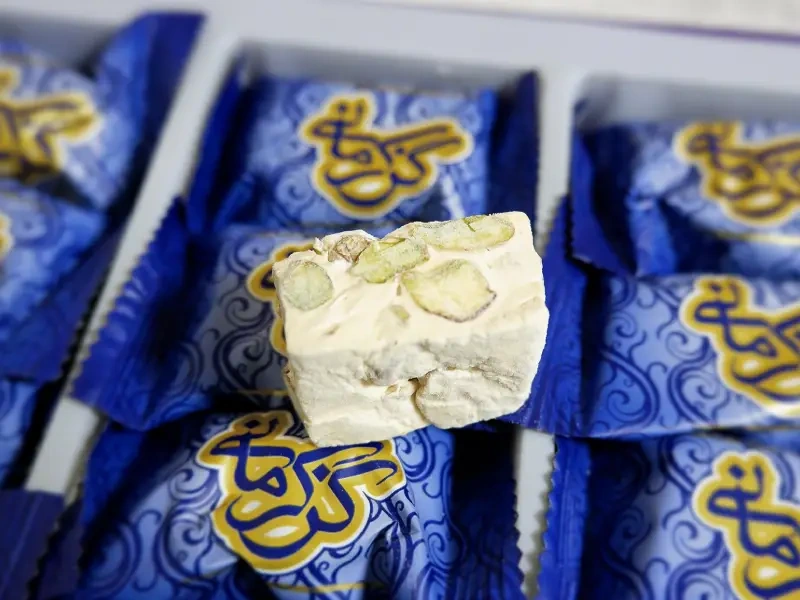
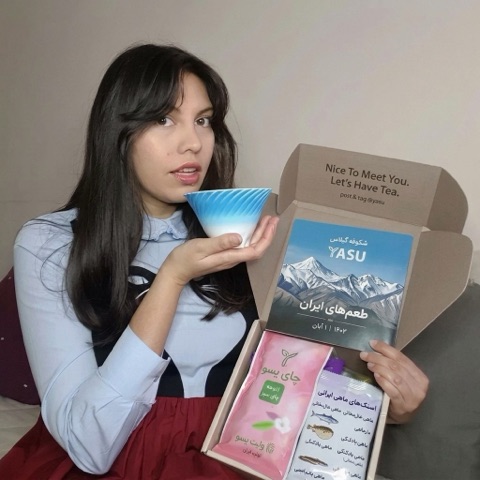
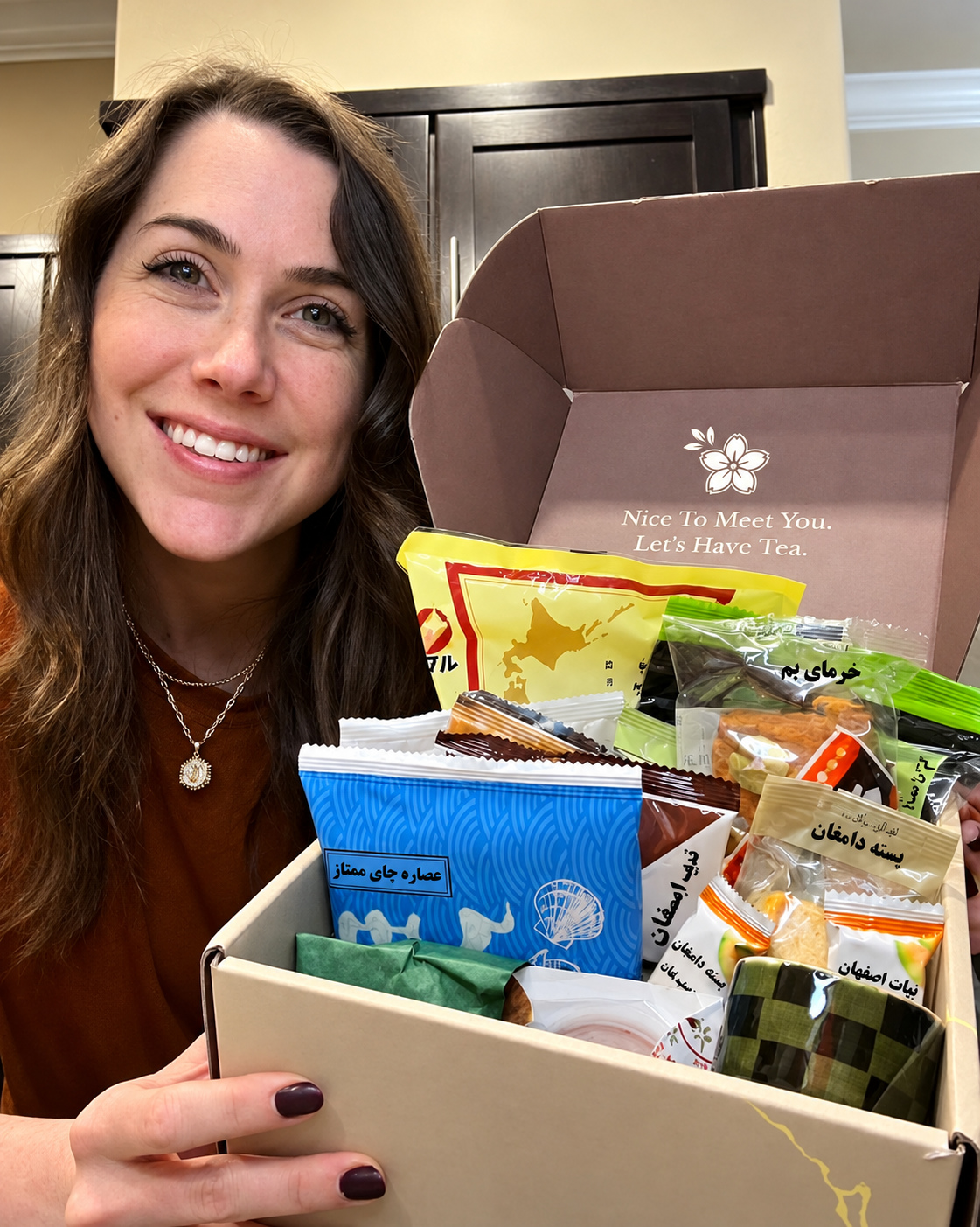
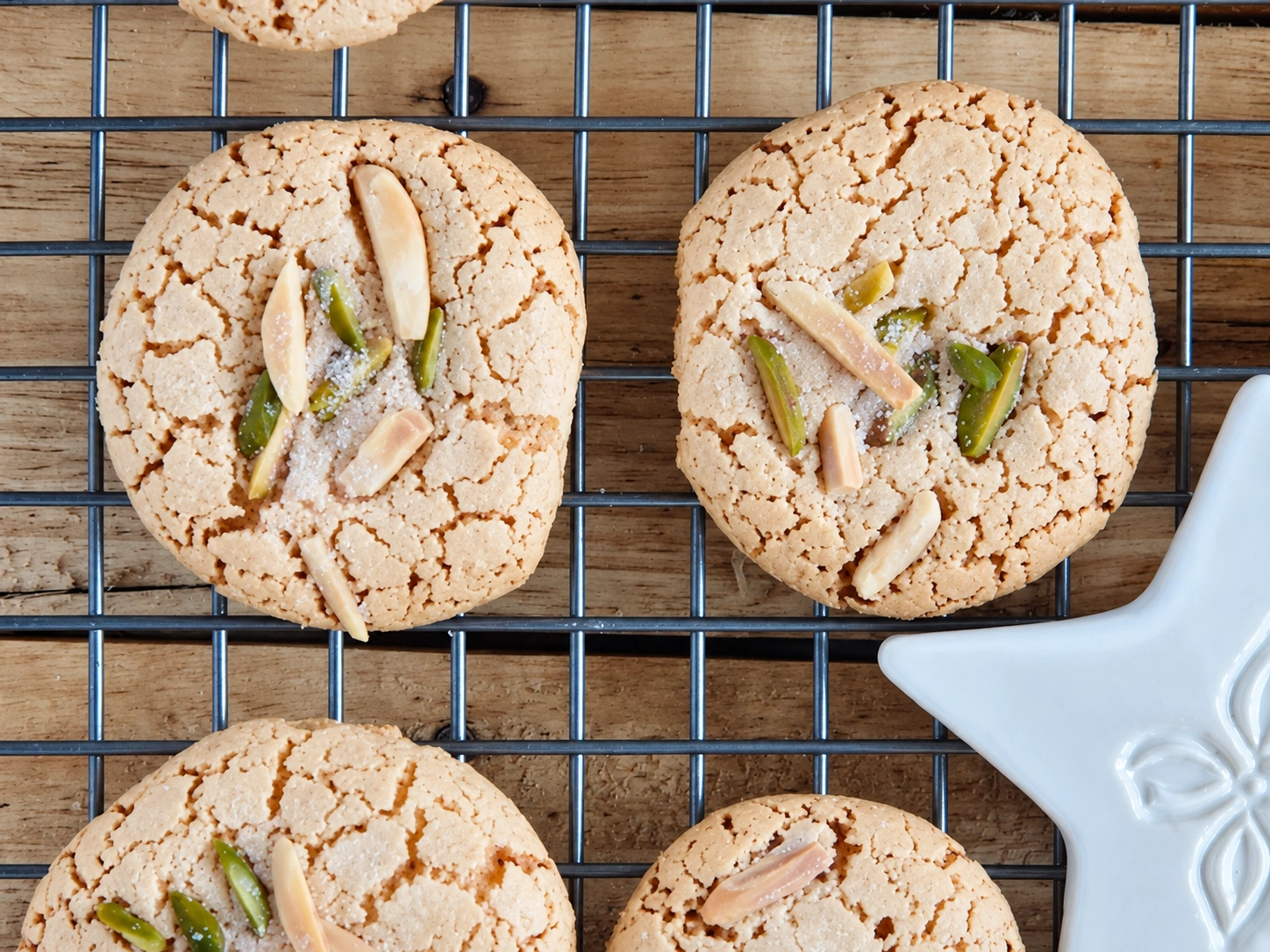
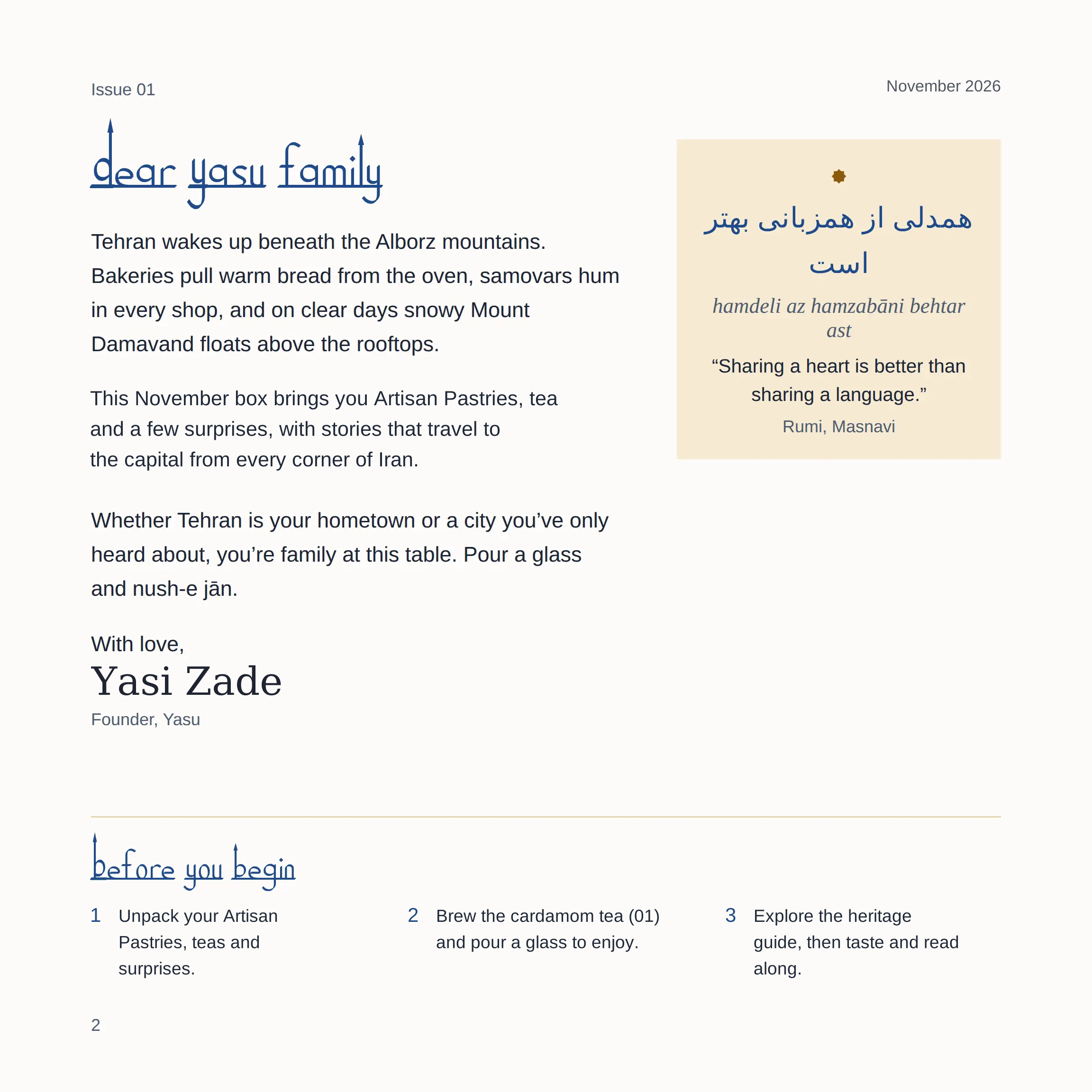
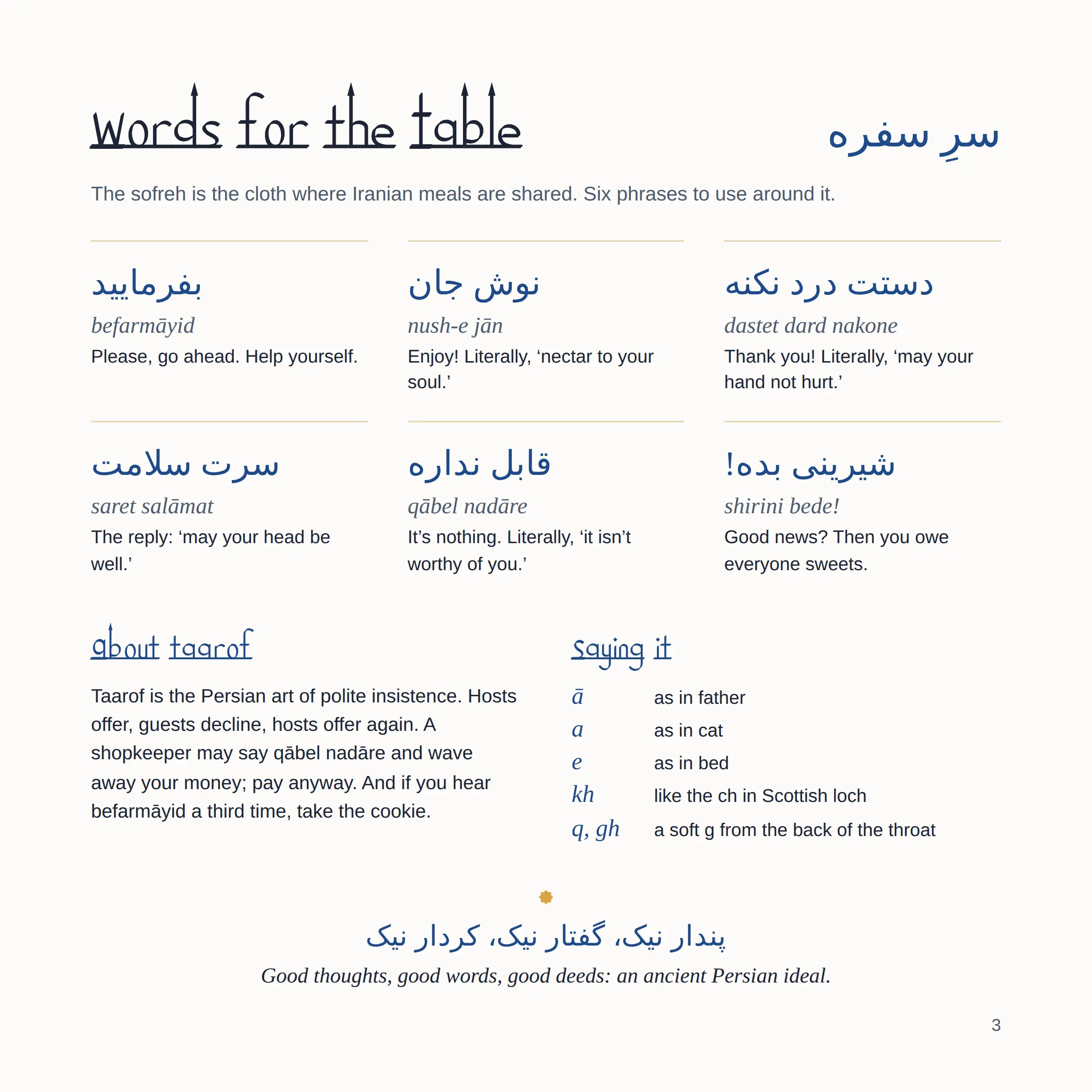
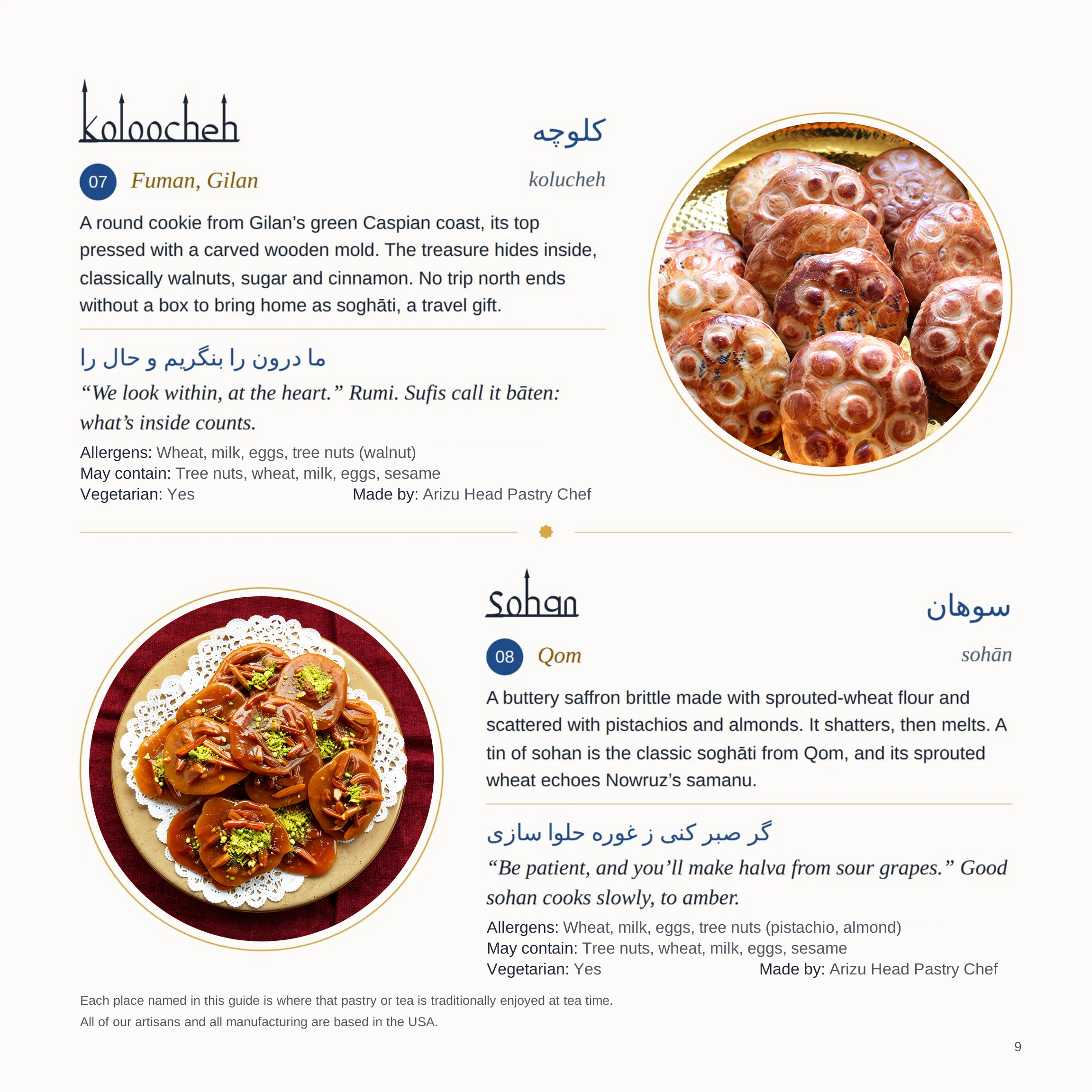
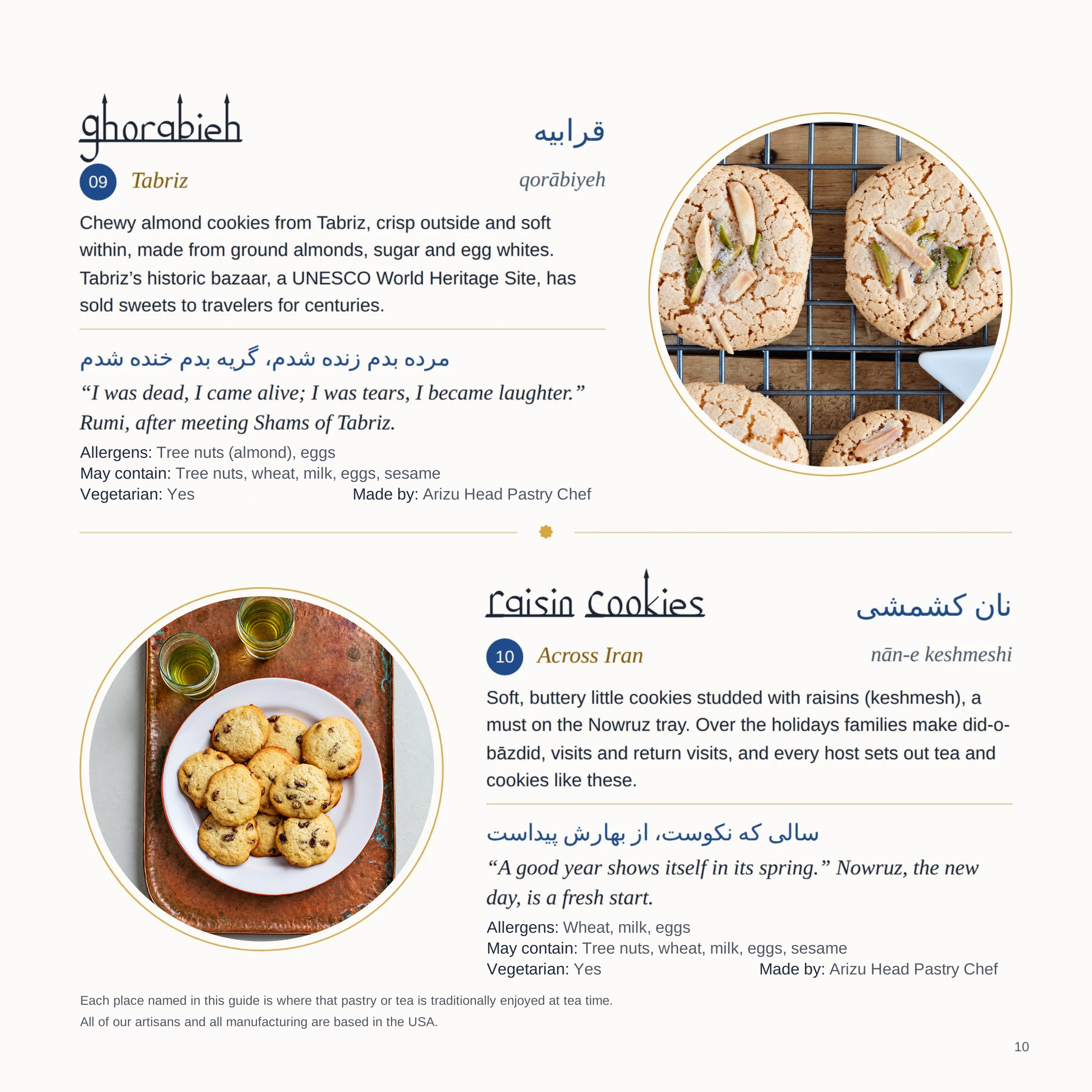
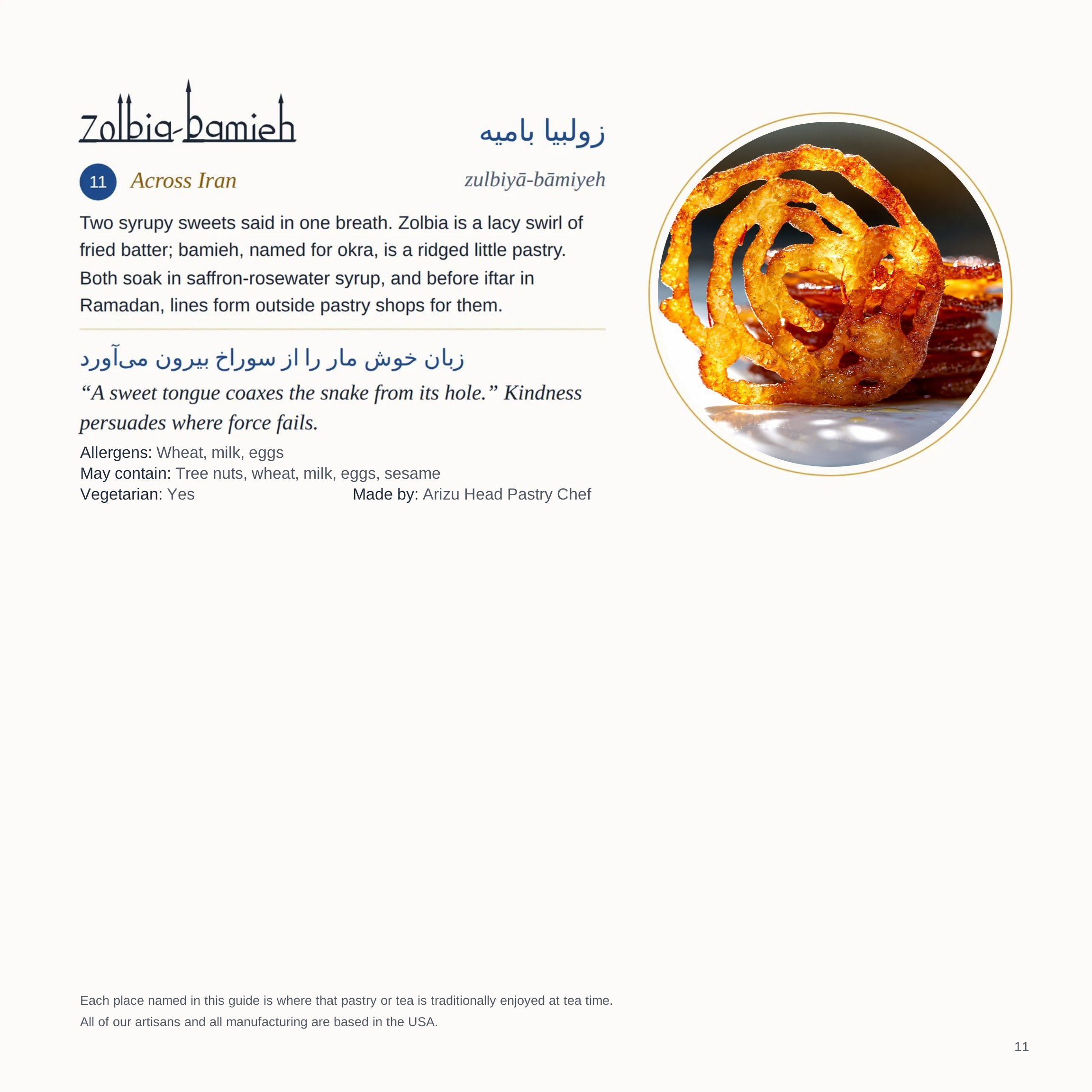
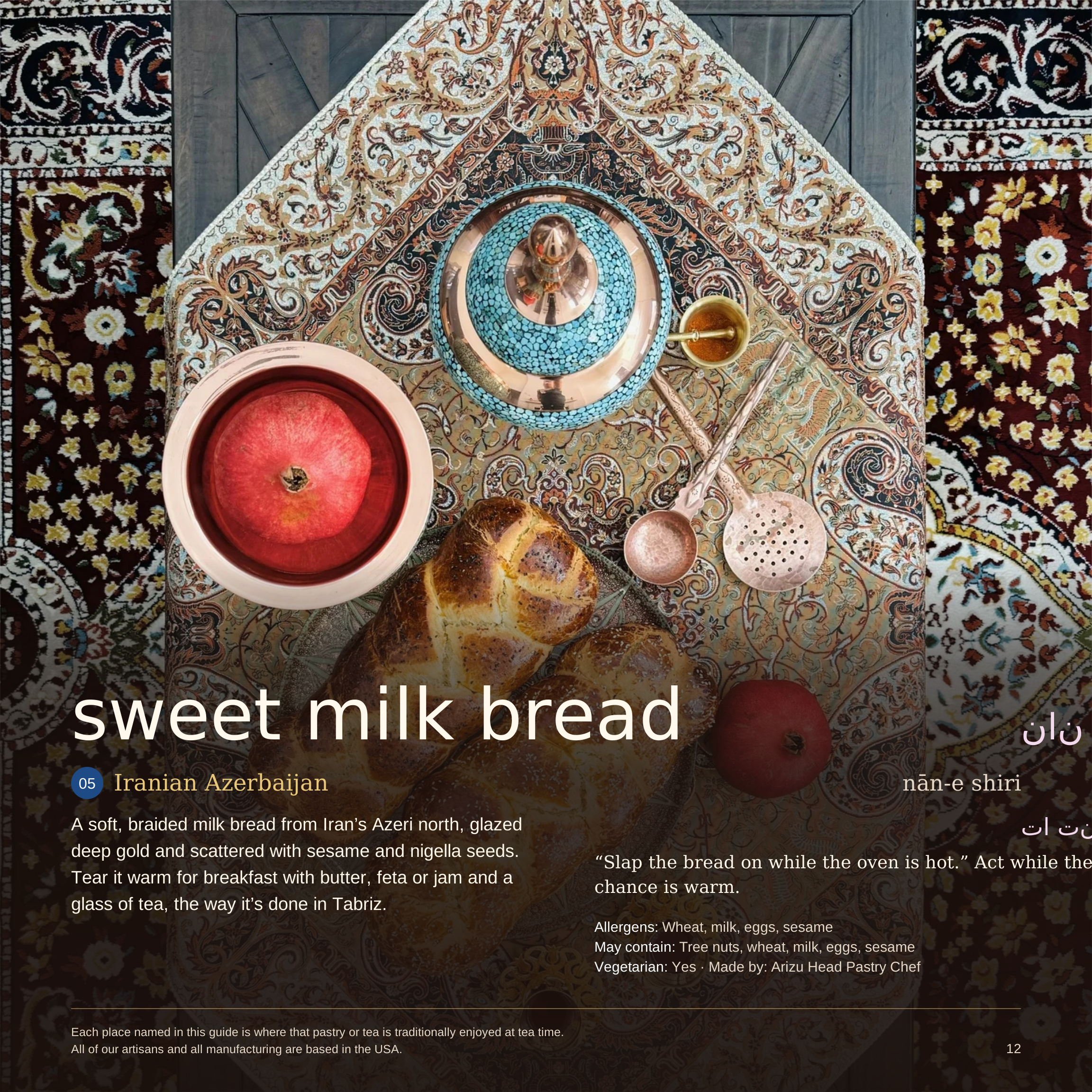
Each monthly box holds a hand-selected mix of Persian pastries & sweets and tea, an illustrated culture guide for that month’s theme, and a few surprises beyond pastries, shipped with your Artisan Pastries. Contents change every month.
How much does it cost?
Choose a plan. The longer the plan, the lower the price per box:
- Monthly: $29.99 per box, billed every month.
- 3 months: $28.49 per box, $85.47 billed every 3 months.
- 6 months: $26.99 per box, $161.94 billed every 6 months.
- 12 months: $25.49 per box, $305.88 billed every 12 months.
Shipping is $6.00 per box to the US, $8.00 per box to Canada, and a flat $19.99 per box to more than 200 other countries. Choose your country in the cart to see your exact rate. On 3-, 6- and 12-month plans, shipping for every box in the plan is charged upfront. Sales tax is added where required.
When am I charged and when does my box ship?
You're charged when you subscribe. Monthly plans are then charged on the same date each month; 3-, 6- and 12-month plans are charged upfront for the whole plan and then on the same date when the plan renews. Either way, one box ships each month, within 14 calendar days of your initial order or the monthly shipment date stated in your order confirmation, and you'll get tracking by email.
Can I cancel, skip or pause?
Yes, anytime, with no fees. Cancel before your next billing date and you won't be charged again. You can cancel online at Manage / cancel subscription. See our Subscription & Auto-Renewal Terms.
I have a food allergy. Is the box safe for me?
Our Artisan Pastries commonly contain tree nuts (pistachio, almond, walnut), wheat, milk, eggs and sesame, and are made in a kitchen that handles all of these. We can't guarantee any item is free of allergens. Please read every label before eating.
Where do you ship?
Worldwide. We ship from the USA to the United States, Canada and more than 200 other countries. Choose your country in the cart to see your shipping rate: $6.00 per box in the US, $8.00 to Canada and a flat $19.99 per box everywhere else. Boxes going outside the US may owe import duties or taxes on delivery.
Can I send a box as a gift?
Yes, anywhere we ship. Choose Gift a Box under the plans, pick 1, 3, 6 or 12 boxes, and add their address and your gift message at checkout. No prices go in the box. For corporate and event gifts, email yasmin@eatyasu.com.
Where are our products made?
Our Artisan Pastries are made by local bakers here in the USA.
Where do your ingredients come from?
We make our Artisan Pastries with organic, locally sourced ingredients.
How do you choose each month's theme?
Each month explores a Persian region, season, celebration or tea tradition. We select Iranian pastries & sweets and surprises to suit the theme.
What do the locations on products and in the pamphlet mean?
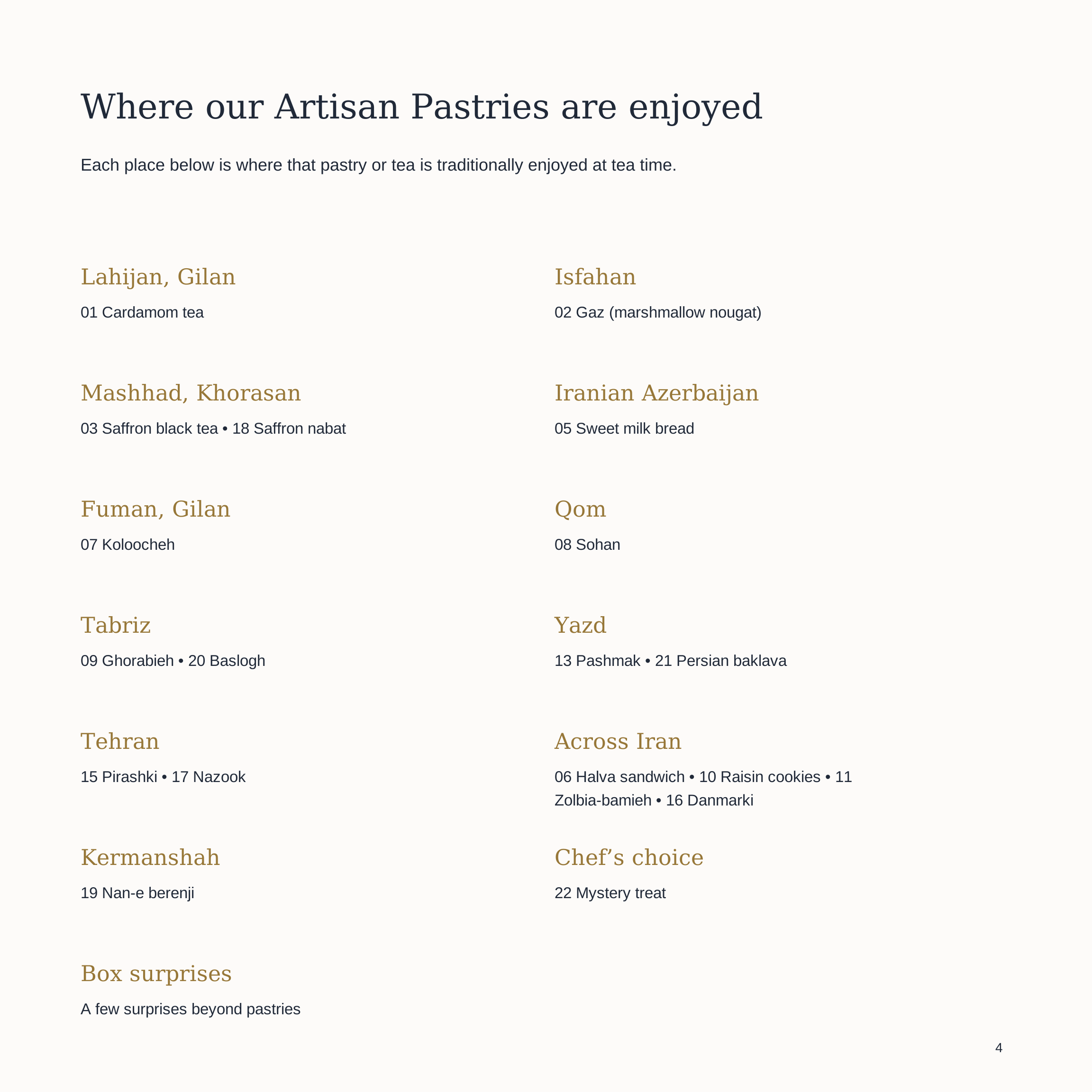
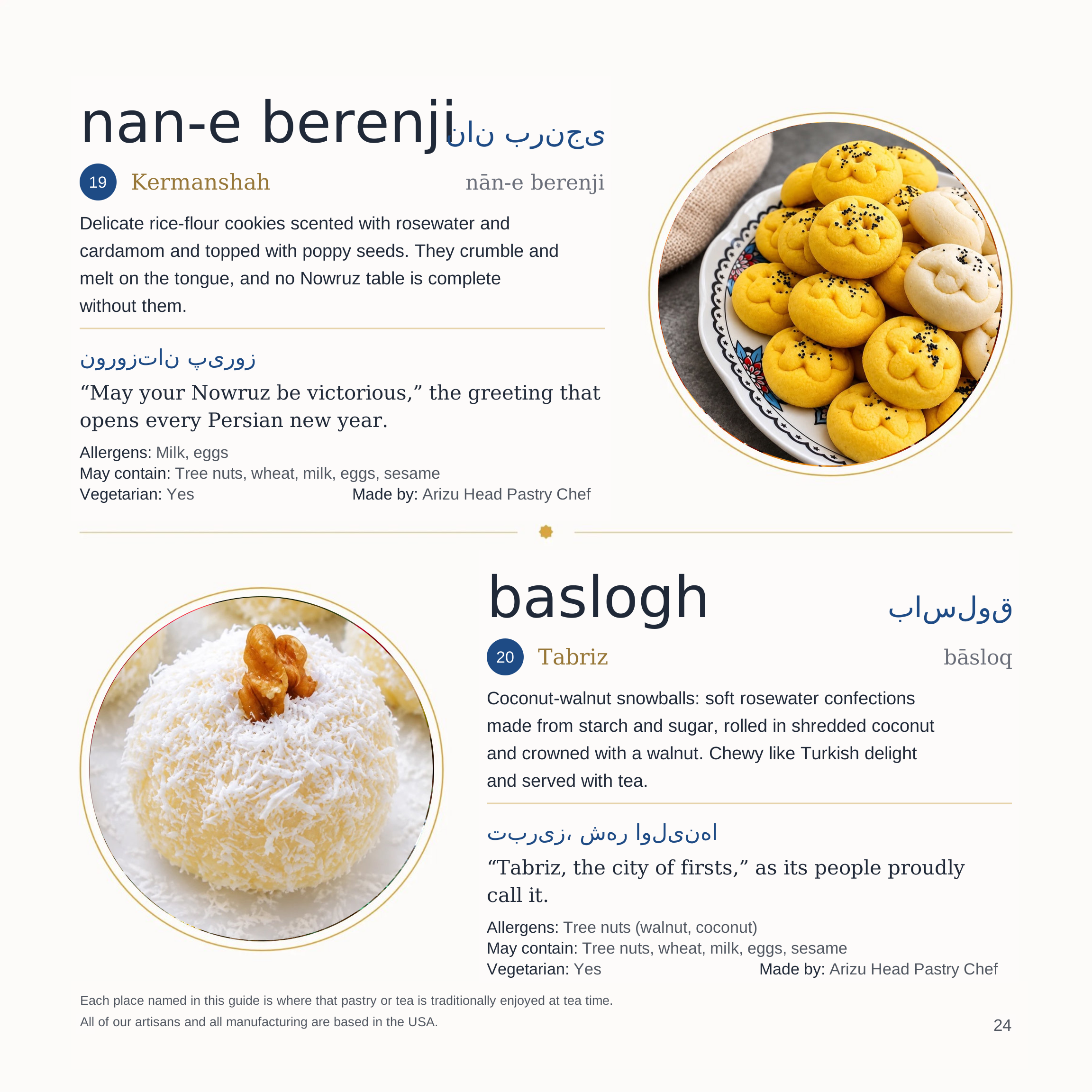
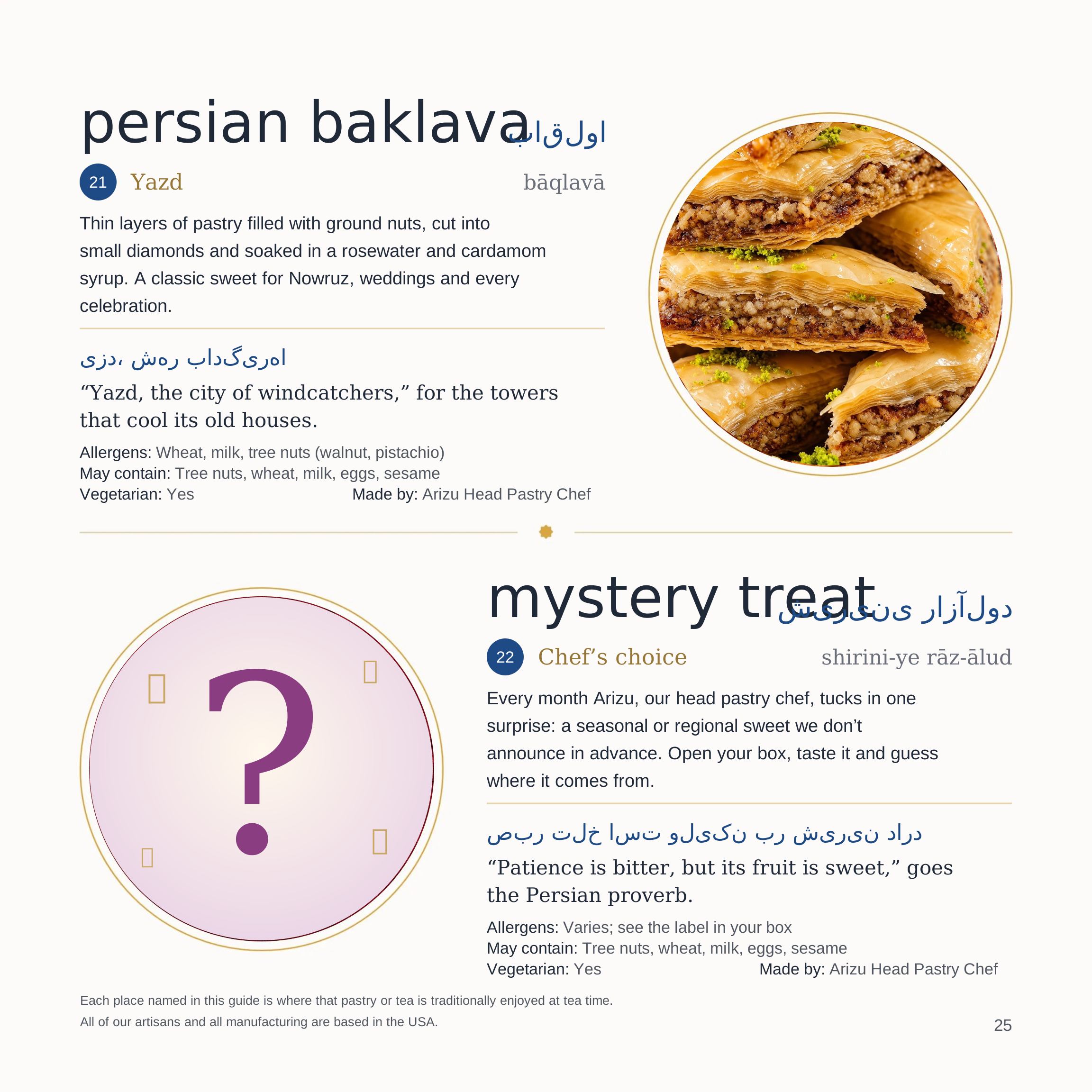
Each location is where that pastry or tea is traditionally enjoyed, often at asrooneh, the Iranian afternoon tea break. They celebrate the regional traditions behind each pastry.
My box arrived damaged or something is missing.
We're sorry. Email yasmin@eatyasu.com within 7 days of delivery with your order number and a photo, and we'll make it right. See our Refund & Cancellation Policy.
Contact Us
We'd love to hear from you. We answer every message within 1 to 2 business days.
Send us a message
Email
yasmin@eatyasu.com
Gifts and corporate orders
For gift subscriptions, event favors or corporate gifting, email yasmin@eatyasu.com with "Gift" or "Corporate" in the subject line and tell us the quantity and dates you have in mind.
Business and mailing inquiries
Yasu (SPY LLC)
200 Locust Street SE
Vienna, VA 22180
Legal
yasmin@eatyasu.com
Privacy
yasmin@eatyasu.com
Founder inquiries
yasmin@eatyasu.com
Order problems
Please include your order number and, for damaged items, a photo. See our Refund & Cancellation Policy.
Terms of Service
Last updated: November 1, 2026
These Terms of Service ("Terms") govern your use of the Yasu website and your purchase of Yasu products and subscriptions. Yasu is operated by SPY LLC, a Virginia limited liability company ("Yasu," "we," "us"), 200 Locust Street SE, Vienna, VA 22180. By using our site or placing an order, you agree to these Terms. No purchase is completed by adding items to the cart; an order requires a successful checkout and order confirmation. If you don't agree, please don't use the site.
1. Eligibility
You must be at least 18 years old and able to form a binding contract to place an order. Orders are available for delivery to the countries listed in the cart.
2. Products
Yasu sells a monthly subscription box of Iranian pastries & sweets, tea and related goods. Box contents vary each month and may be substituted with items of similar value. The number of items we describe, such as “20+ Authentic Persian Pastries & Sweets,” is approximate and may change based on the size of each month’s items; a box with larger items may contain fewer pieces. Photos on the site are for illustration; actual items, packaging and presentation may differ. Food items are perishable; please follow the storage and best-by information on each label.
3. Prices, payment and taxes
Artisan Pastries Box plans cost $29.99 per box (monthly), $28.49 per box (3-month plan, $85.47), $26.99 per box (6-month plan, $161.94) or $25.49 per box (12-month plan, $305.88), plus shipping per box: $6.00 in the US, $8.00 to Canada, or the rate shown in the cart for other countries. When available, Market items are priced as shown and ship for one flat charge per order at the same rate, or free with a box. Applicable sales tax is added at checkout. Prices are in U.S. dollars. Payments are handled by our payment processor, Stripe; we do not store your full card number. We may change prices with notice as described in our Subscription & Auto-Renewal Terms.
4. Subscriptions
Subscriptions renew automatically at the end of each plan period (monthly, or every 3, 6 or 12 months) until you cancel. Our Subscription & Auto-Renewal Terms are part of these Terms.
5. Orders
We may refuse or cancel any order, for example if an item is unavailable, if we suspect fraud, or if there's an error in pricing or product information. If we cancel an order after you've been charged, we'll refund you in full.
6. Shipping, returns and refunds
See our Shipping Policy and Refund & Cancellation Policy, which are part of these Terms.
7. Allergens and food safety
Our products are made in a kitchen that handles tree nuts (including pistachio, almond and walnut), wheat, milk, eggs and sesame. You are responsible for reading every label and deciding whether a product is safe for you and anyone you share it with. See Food Safety, Licensing & Allergens.
8. Intellectual property
The Yasu name, logo, website design, text, photographs, illustrations, culture guides and pamphlets are owned by or licensed to Yasu and protected by copyright and trademark law. You may view and share them for personal, non-commercial use, but you may not copy, sell or reuse them commercially without our written permission.
9. Acceptable use
You agree not to misuse the site, including by attempting to gain unauthorized access, interfering with its operation, scraping it, or using it for any unlawful purpose.
10. Disclaimers
Except as stated in these Terms and to the extent permitted by law, the site and products are provided "as is" without warranties of any kind, express or implied, including warranties of merchantability and fitness for a particular purpose. Nothing in these Terms limits any rights you have under consumer protection laws that cannot be waived.
11. Limitation of liability
To the fullest extent permitted by law, Yasu will not be liable for indirect, incidental, special or consequential damages, and our total liability for any claim relating to the site or products will not exceed the amount you paid us in the three months before the claim. Some states do not allow these limits, so they may not apply to you.
12. Indemnity
You agree to indemnify Yasu against claims arising from your misuse of the site or violation of these Terms.
13. Governing law
These Terms are governed by the laws of the Commonwealth of Virginia, without regard to conflict-of-law rules. Any dispute will be brought in the state or federal courts located in Fairfax County, Virginia, and you consent to their jurisdiction, except where the law of your state requires otherwise.
14. Changes
We may update these Terms from time to time. We'll post the new version here with a new "Last updated" date, and we'll notify active subscribers by email of material changes. Continuing to use the site or your subscription after a change means you accept it.
15. Contact
Yasu (SPY LLC), 200 Locust Street SE, Vienna, VA 22180. Email: yasmin@eatyasu.com.
Subscription & Auto-Renewal Terms
Last updated: November 1, 2026
Summary: You choose a plan: Monthly ($29.99 per box), 3 months ($85.47), 6 months ($161.94) or 12 months ($305.88), plus shipping per box ($6.00 in the US, $8.00 to Canada, or the rate shown in the cart for other countries) and any sales tax. Your plan renews automatically at the same price and length, and your payment method will be charged at the start of each new plan period until you cancel. You can cancel anytime, online or by email, and you won't be charged again.
1. Automatic renewal
When you subscribe, you authorize us to charge your payment method immediately for your plan and its shipping, plus applicable tax: $35.99 for the Monthly plan, $103.47 for 3 months, $197.94 for 6 months or $377.88 for 12 months (to Canada: $37.99, $109.47, $209.94 or $401.88; to other countries, the plan price plus that country’s shipping rate for each box, as shown in the cart and at checkout). We will charge the same amount again on the same calendar date at the end of each plan period (or the last day of the month, if that date doesn't exist) until you cancel. Before you complete your first purchase, we'll ask you to confirm that you agree to automatic renewal.
2. How to cancel
You can cancel at any time, with no cancellation fee:
- online, anytime, at Manage / cancel subscription (enter the email on your subscription and we'll send you a secure sign-in link); this link is also in your subscription confirmation, or
- by emailing yasmin@eatyasu.com with the subject "Cancel" and the email address on your subscription.
Cancellations received before your next billing date stop all future charges. Boxes you have already paid for still ship, and your subscription ends after the last one. Prepaid plans: if you cancel a 3-, 6- or 12-month plan within 14 days of purchase and before your first box ships, we'll refund it in full. After that, the remaining paid boxes ship as scheduled and the plan won't renew; we don't give partial refunds for unshipped boxes in a prepaid plan, except where the law requires.
3. Confirmation and reminders
After you subscribe, we'll email you a confirmation that includes these terms and how to cancel. Where required by law, we'll also send a reminder before a renewal charge.
4. Skipping or pausing
Contact yasmin@eatyasu.com before your next billing date to request a skip or pause. We will confirm the revised shipment and billing schedule before applying the change. Canceling renewal does not require approval of a pause request.
5. Price changes
If we change the subscription or shipping price, we'll email you at least 30 days before the new price applies, giving you time to cancel. If you don't cancel, the new price will apply from your next billing date after that notice.
6. Failed payments
If a renewal payment fails, we may retry it and will let you know. If we can't collect payment, we may pause or end your subscription.
7. Gift boxes
Choose Gift a Box to send a box as a gift. You pay at checkout for the number of boxes you choose (1, 3, 6 or 12, including shipping, plus any tax). A gift is not a subscription. Enter the recipient’s name and address as the shipping address and add your name and an optional gift message at checkout; we include your message in the box. Gift boxes ship one box each month, and we never put prices or receipts in a gift box. Your receipt is emailed to you. Our prepaid-plan refund rules above apply to gifts.
Shipping Policy
Last updated: November 1, 2026
Where we ship
We ship to the United States, Canada and more than 200 other countries. Choose your country in the cart before checkout; secure Stripe checkout then accepts any address in the international shipping area, so the shipping you pay always matches where your box goes. We can't ship to countries under U.S. sanctions or where postal service is suspended, including Russia, Belarus, Cuba, Iran, North Korea, Syria and Somalia.
Cost
Shipping is $6.00 per box to the United States, $8.00 per box to Canada, and a flat $19.99 per box to every other country we ship to. Your exact rate appears in the cart as soon as you choose your country. International boxes travel by USPS First-Class Package International with tracking. On 3-, 6- and 12-month plans, shipping for every box in the plan is charged upfront with the plan. When available, Market items ship free with a box, or for one flat charge at your country’s rate when ordered on their own.
Orders outside the United States
Prices are in U.S. dollars, and your card issuer may apply a currency conversion fee. Boxes are shipped from the United States, so import duties, VAT, GST/HST or carrier fees may be charged on delivery; these are the recipient's responsibility. International delivery usually takes 1 to 4 weeks. Some countries restrict imported food; please check that baked goods, sweets, nuts and tea can be received where you live.
When your box ships
One box ships each month, within 14 calendar days of your initial order or the monthly shipment date stated in your order confirmation. Once your box ships, we'll email you a tracking number. The 14-day period is a dispatch promise, not a delivery guarantee. Transit time depends on your location and the carrier. When available, Market-only orders ship within 14 calendar days of purchase. If we cannot ship within the promised period, we will ask for your consent to the delay or refund the unshipped order.
Freshness
Our Artisan Pastries are baked and packed close to shipping and sealed for freshness. Please open your box promptly, check the best-by date on each item, and store items as labeled. In very hot weather, some chocolate- or butter-based items may be swapped for heat-stable Artisan Pastries.
Address accuracy
Please make sure your shipping address is correct. We aren't responsible for boxes sent to an address entered incorrectly, but we'll help however we can.
Lost or late boxes
If your tracking shows no movement for 7 days, or your box hasn't arrived within 10 business days of shipping, email yasmin@eatyasu.com and we'll work with the carrier and, if needed, send a replacement or issue a refund.
Refund & Cancellation Policy
Last updated: October 7, 2026
Cancellations
You can cancel your subscription anytime. See Subscription & Auto-Renewal Terms for how. Canceling stops future charges; it does not refund boxes that have already been charged. Prepaid 3-, 6- and 12-month plans can be refunded in full if canceled within 14 days of purchase and before the first box ships.
Returns
Because our products are food, we can't accept returns of opened or unopened items, for health and safety reasons.
Damaged, missing or wrong items
If anything arrives damaged, spoiled, missing or incorrect, email yasmin@eatyasu.com as soon as possible, preferably within 7 days of delivery with your order number and a photo. We'll send a replacement or refund the affected item, or the whole box if needed.
Charged by mistake
If you were charged after canceling, or charged twice, email us and we'll refund the charge in full.
How refunds are issued
We issue approved refunds to the original payment method; your bank may take 5 to 10 business days to post the credit. Nothing in this policy limits rights that cannot be waived under applicable law.
Privacy Policy
Last updated: November 1, 2026
This Privacy Policy explains how Yasu ("Yasu," "we") collects, uses and protects your personal information when you visit our website, subscribe, or contact us.
Information we collect
- Information you give us: your name, email, shipping and billing address, phone number (optional), order details, gift recipient details, and anything you write to us.
- Payment information: handled directly by our payment processor, Stripe. Depending on what you choose at checkout, your payment may also be handled by Link, Klarna, Cash App Pay or Amazon Pay. We do not receive or store your full card number. Stripe's use of your information is described in the Stripe Privacy Policy.
- Automatic information: basic technical data such as browser type, device and requested pages may be processed by our website host. External font requests also share technical request data with the font provider. No analytics integration is present in this version of the site.
How we use it
To process and ship your orders, manage your subscription, send order confirmations and renewal notices, answer your messages, send our newsletter if you sign up, prevent fraud, and meet our legal obligations.
Cookies and browser storage
Our site uses your browser’s local storage to remember your cart. You can clear this information by clearing site data in your browser. We do not use advertising or cross-site tracking cookies. If we add analytics or marketing tools later, we'll update this policy.
Sharing
We do not sell or rent your personal information. We share it only with service providers who help us run the business, such as our payment processor (Stripe), shipping carriers, email service and website host, and only as needed for them to do that work; when required by law; or if the business is sold or reorganized.
Email
You can unsubscribe from marketing emails at any time with the link in any email. We'll still send emails about your orders and subscription.
Data retention and security
We keep your information as long as needed to serve you and meet legal, tax and accounting requirements, and we use reasonable safeguards to protect it.
Your choices and rights
You can ask us to access, correct or delete your personal information, or to stop marketing emails, by emailing yasmin@eatyasu.com. Depending on where you live (for example Virginia, California or another state with a consumer privacy law), you may have additional rights, and we'll honor requests as those laws require.
Children
Our site isn't directed to children under 13, and we don't knowingly collect their information.
Changes
We'll post updates here with a new "Last updated" date.
Contact
Yasu (SPY LLC), 200 Locust Street SE, Vienna, VA 22180. Email: yasmin@eatyasu.com.
Food Safety, Licensing & Allergens
Last updated: November 1, 2026
Where our Artisan Pastries are made
Our Artisan Pastries are made by local bakers here in the USA. The places named in our guide are where each pastry is traditionally enjoyed. Yasu pastries & sweets are prepared and packaged in the licensed commercial kitchen of Yas Bakery, 137 Church St NW, Vienna, Virginia 22180. For information about the facility’s current food-safety authorization, contact yasmin@eatyasu.com.
Business operator: SPY LLC, 200 Locust Street SE, Vienna, VA 22180.
Labeling
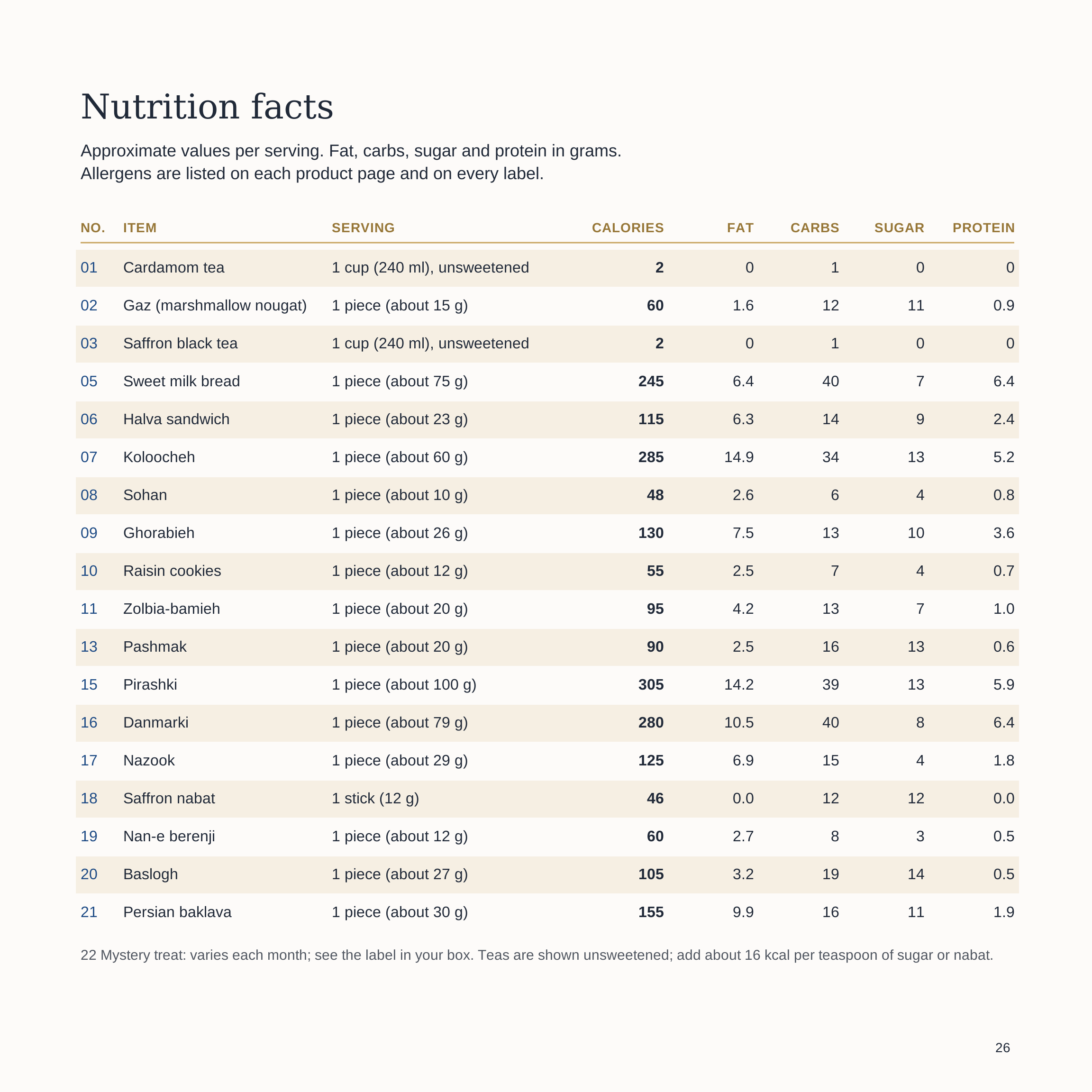
Food labels provide the product name, ingredients, net quantity, required allergen declarations and responsible manufacturer, packer or distributor information. Nutrition labeling applies unless a valid exemption applies. Follow any storage and best-by guidance on the package. Teas and packaged goods from other producers carry their original labels, including country of origin.
Allergen statement
Allergen and cross-contact information: Our products are made in a kitchen that also handles tree nuts (including pistachio, almond and walnut), wheat, milk, eggs and sesame. Cross-contact is possible, and we cannot guarantee that any product is free of any allergen. Always read the label on each item before eating it.
Storage and freshness
Store items as shown on their labels and enjoy them by the best-by date. Do not eat any item whose packaging is damaged, swollen or open on arrival; contact us for a replacement.
Questions
For ingredient or allergen questions about a specific item, email yasmin@eatyasu.com before eating it.
Accessibility Statement
Last updated: October 7, 2026
We want everyone to be able to use the Yasu website. We aim to meet the Web Content Accessibility Guidelines (WCAG) 2.1, Level AA, and we keep working to improve.
If you have trouble using any part of the site, or need information in another format, email yasmin@eatyasu.com. We'll respond within 2 business days and help you place your order another way if needed.